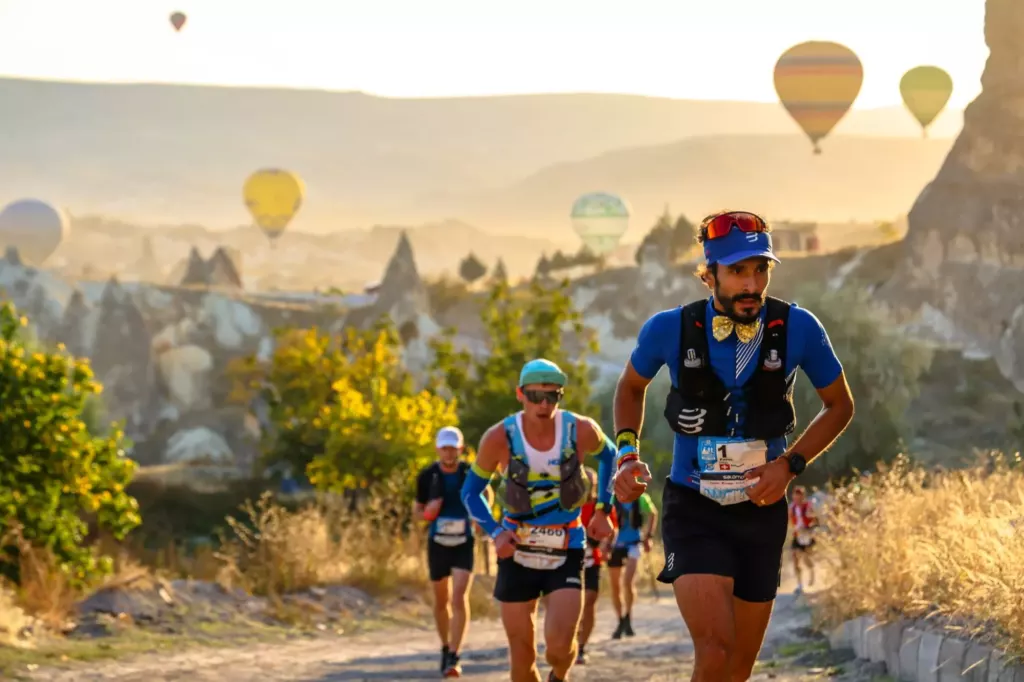
Combining running and sightseeing is no longer marginal: from the AlUla duathlons to the Tokyo and London marathons, many travellers now choose their destination for a race. Testimonials, economic impacts and practical tips to prepare a “race-cation.”
Traveling to participate in a race — marathon, half, duathlon or trail — is now established as a lasting trend. “Race-cations” are changing the way people discover a place: far from classic tourism, they offer a perspective shaped by effort, camaraderie and local discovery. The rise of run clubs, fitness influencers and growing interest in wellbeing help explain this phenomenon, which is particularly visible among residents of the United Arab Emirates.
Unexpected playgrounds and international gatherings
A recent example: the inaugural AlUla Duathlon held in October in the UNESCO World Heritage region. The event, part of the AlUla Wellness festival, brought together participants from more than 30 nationalities and allowed amateurs to run and cycle amid spectacular desert landscapes.
Across destinations, the practice leads to unique experiences: a 10K trail on the Great Wall of China, half marathons in Samarkand or Almaty, races that run alongside millennia‑old monuments like the Giza pyramids, or popular courses in Japan where crowd support is often an integral part of the race.
Runners speak: why travel to run?
Several runners living in the Emirates share the motivations that lead them to turn trips into sporting appointments. Joanna Budair, from Abu Dhabi, has completed 11 marathons abroad and regularly runs half marathons from Sydney to New York, via Amman and Jeddah. She highlights the communal aspect of the sport: even when travelling solo, the camaraderie of fellow runners protects her from loneliness, sometimes even during international crises — “when the war between the United States, Israel and Iran broke out on February 28, the day before the Tokyo marathon I was registered for, a runner friend convinced me to take part,” she says.
The best thing about running is the friendships. We come from different countries, but we are united by the same passion.
Kyle Tinson, a 26‑year‑old Dubai resident and personal trainer, ran a 10K on the Great Wall of China: “Epic views, steps, uneven surfaces and a lot of wind — all of that made the race memorable,” he says. By the end of the year he hopes to have taken part in 12 international races, including Tokyo and Seoul.
Charlotte Jade, from Abu Dhabi, favors nearby but exotic destinations: Almaty, Samarkand and the Riyadh half marathon in January 2026 were on her race calendar. She values the long‑weekend format that combines a sporting challenge with cultural immersion: “I had time to taste the local cuisine, explore the cultural district and meet local runners.”
Carine Duvignaud, who only took up racing in 2023, describes the personal impact: after a boxing session at a training camp in Thailand, she kept travelling for sport and ran the Marakez Pyramids Half Marathon in Cairo in December, enjoying a unique panorama of the Great Sphinx and the Great Pyramid of Giza.
A real economic boon
Race‑related tourism now carries significant weight. The London Marathon 2026 reached a symbolic milestone by attracting 1.1 million applications — the first time its entry lottery topped one million. According to Marathon Handbook, organizers of the seven Abbott World Marathon Majors — some of the most prestigious marathons in the world — now generate more revenue than Super Bowl host destinations. These figures highlight the economic impact of races: accommodation, dining, transport, specialized services (bike workshops, nutrition, coaching) and merchandising.
Moreover, races help put less‑visited cities on the map. Central Asian or Middle Eastern capitals are thus appearing on itineraries of runners from the Gulf, attracted by short flights and lower costs compared with long‑haul travel.
How to succeed at a “race‑cation”: practical tips
Beyond motivations, traveling for a race requires tailored preparation. Here are recommendations based on the experiences of runners and coaches:
Before departure
- Manage jet lag: allow time for adaptation when possible and use tools like the Timeshifter app, which offers light‑exposure strategies, naps and caffeine timing to resynchronize your biological clock.
- Limit conflicting circadian cues: avoid scheduling meals at times corresponding to local nighttime to speed up adjustment.
- Label and track your gear: use trackers (AirTag, for example) on bikes or sensitive luggage to monitor equipment in case of loss or diversion.
Logistics and race day
- Plan equipment logistics: book a local bike shop for a final check after transport, bring your own race‑day nutrition and have a plan B for your morning coffee.
- Think of accompanying guests: choosing a spectator‑friendly course (loops, repeated sections) lets companions enjoy the race without getting bored between laps.
- Anticipate the unexpected: arrive early, be ready to pivot in the face of a technical issue (sensor failure, connectivity problems) and allow time to find a solution rather than panic.
After the finish line
- Race first, sightseeing later: schedule tourist activities after the main effort to better enjoy them and recover without constraint.
- Plan for rest: the urge to celebrate is strong, but adequate post‑race rest improves recovery and the rest of your trip.
What a “race‑cation” brings to the traveller and destinations
Motivations vary: the pursuit of a personal challenge, the desire to see a place differently, the search for shared experiences and the chance to combine performance with discovery. For cities, hosting international races means attracting visitors outside traditional tourist circuits, generating sustainable revenue and developing sport and wellbeing offerings.
At the same time, the race‑cation trend raises questions: infrastructure, crowd management, the carbon footprint of travel and accessibility of events for amateur athletes. Organizers and local authorities will therefore need to design formats that balance economic benefits and sustainability requirements.
In conclusion
Running while travelling is no longer a niche: it’s a deeply immersive way to discover a territory, forge connections and collect experiences. Whether a duathlon at sunrise in AlUla, a half marathon among historic monuments or a 10K on the Great Wall, racing is redefining tourism. To get the most out of it, you need thoughtful preparation, a measure of flexibility and openness to the encounters each starting line brings.
Sources : Condé Nast Traveller Middle East, 7 Things You Absolutely Need to Know Before Your First ‘Race-Cation’