A measure that relates overnight stays to the number of residents reveals that several Swiss alpine municipalities are visited much more “intensely” than popular European capitals and islands.
The phenomenon of “victim destinations”
Overtourism has become a recurring topic: after the pandemic, visitor numbers rose sharply and residents of some tourist destinations are expressing their frustration. In Switzerland, nearly 43 million overnight stays were recorded in hotels last year, a level never before reached according to the Federal Statistical Office (FSO).
Measuring tourism intensity
To go beyond total overnight stays alone, the European Commission developed an indicator, “tourism intensity”, calculated by dividing the number of overnight stays by the resident population. This indicator takes into account the size of municipalities and better captures a destination’s “vulnerability” to overtourism.
“Tourism intensity” is calculated by dividing the number of overnight stays by the resident population.
Concentrations in Switzerland
The 186 municipalities with more than three establishments regularly open account for 80% of total overnight stays; the other municipalities cannot be published by the FSO for data protection reasons. Valais, the Bernese Oberland, Graubünden and the Lake Lucerne region emerge as the most affected areas, partly because the most visited municipalities are often small in size.
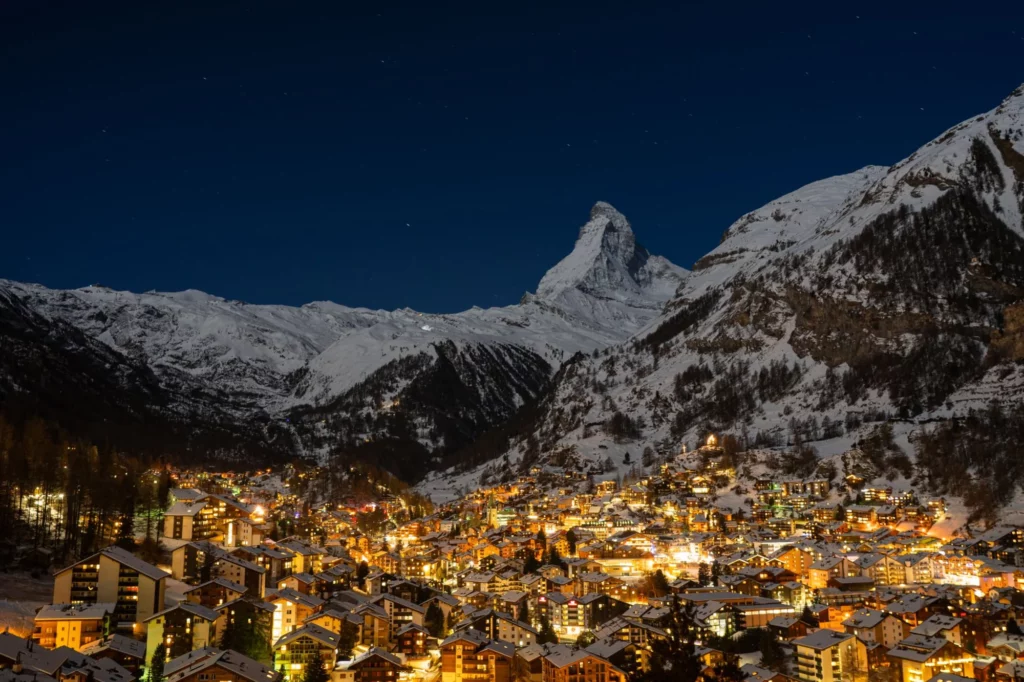
- Zermatt: more than 1.6 million overnight stays and about 6,000 residents, corresponding to a tourism intensity of 269 overnight stays per resident (the highest among the municipalities analyzed).
- Lauterbrunnen and Grindelwald: 215 and 210 overnight stays per resident, completing the Swiss podium.
- Other leading municipalities: St. Moritz, Loèche‑les‑Bains, Saas‑Fee and Interlaken.
In total, 13 Swiss municipalities exceed a tourism intensity of 100 overnight stays per resident. Some Greek islands show comparable values.
European comparisons and consequences
For comparison, according to Eurostat, Mallorca and Paris recorded intensities of 57 and 20 overnight stays per resident in 2024. In Venice, Amsterdam and Barcelona the indicator was 47, 18 and 7 respectively, therefore lower than those of the most “intensely” visited Swiss localities.
Swiss cities, although they record the largest absolute numbers of overnight stays (Zurich ~4 million, Geneva ~2.3 million, Basel ~1.5 million), show lower intensities, generally between 7 and 16 overnight stays per resident.
The European Commission reminds that strong concentrations of tourists can lead to negative consequences: imbalances in tourism development, pressure on the housing market and cost of living, strain on resources and vulnerability to demand shocks.
Source: watson.ch/fr