From Geneva to the Vallée de Joux, Swiss watchmaking unfolds across museums, manufactories and public clocks. Centuries-old heritage, craftsmanship recognized by UNESCO, and a thriving industry: the stops on a horological pilgrimage.
Intangible heritage and four centuries of history
In 2020, UNESCO inscribed watchmaking skills and mechanical art on the intangible cultural heritage list, praising traditions that combine technique, science and aesthetics. The story begins in the 16th century in Geneva: after Calvin’s sermons, goldsmiths and jewellers turned to making “watch cases.” The regions around Lake Geneva and the Jura arc specialized and later prospered in the 19th century thanks to new technologies and increased precision.
Among the old houses are Blancpain (founded 1735), Vacheron-Constantin (1755), Breguet (1775) and Chaumet (1780). Abraham-Louis Breguet, a major figure, invented the tourbillon and designed the first wristwatch mentioned in tradition as linked to one of Napoleon’s sisters.
Public clocks and major cities
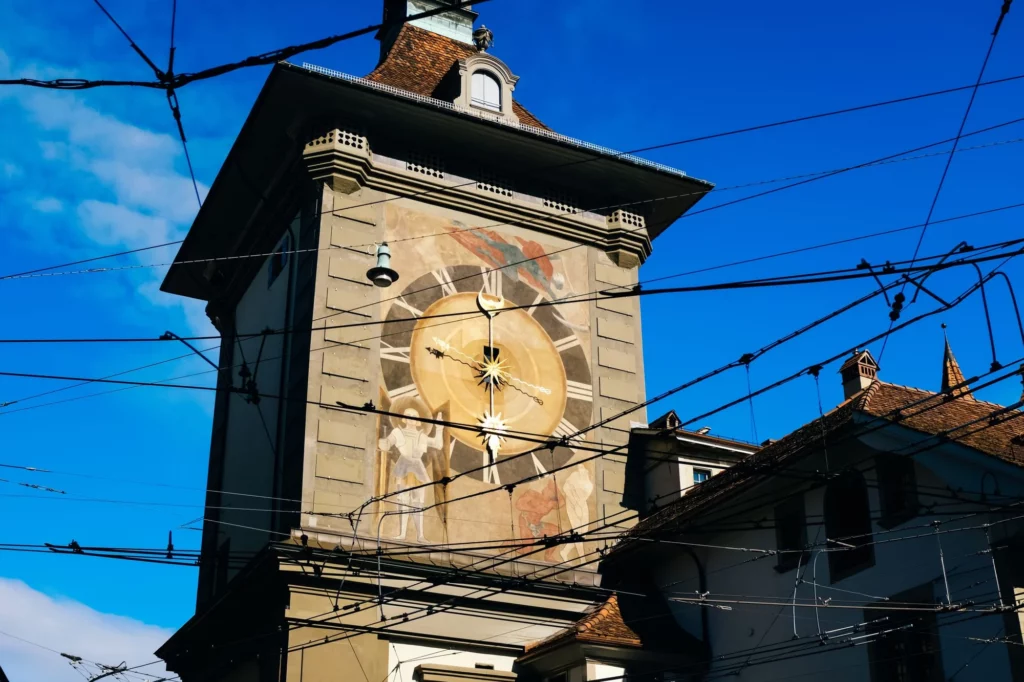
In urban centres, clock towers mark daily life: Bern’s Zytglogge (mechanism from 1530) has animated its carillon and automata for centuries. In Lucerne, the Zytturm, whose current clock dates from 1535, is wound by hand every day and chimes one minute before the city’s other clocks. In Zug, the 1574 astronomical clock shows the days, moon phases, zodiac signs and leap years.
Production centres and museums
La Chaux-de-Fonds and Le Locle, listed as World Heritage for their watchmaking urban planning, house manufactories and museums. La Chaux-de-Fonds hosts several maisons (TAG Heuer, Breitling, Chanel, Cartier) and the legacy of Le Corbusier, who was born there. The Musée international d’horlogerie holds the world’s largest collection (more than 4,000 pieces) but is closed for renovation until 2026.
Le Locle, home to a watchmaking cluster and the Contrôle Officiel Suisse des Chronomètres (COSC), offers a watchmaking trail and a museum installed in an 18th-century building. Houses such as Ulysse Nardin, Audemars Piguet, Rolex, Certina, Tissot, Tudor and Zenith are located there; the Zenith manufacture, founded in 1865, opens for visits on Friday mornings (3-hour tour, 50 CHF).
Vallée de Joux and grand complications
The Vallée de Joux is the cradle of grand complications. Pierre LeCoultre, a Huguenot refugee who arrived in 1559, is the ancestor of Antoine LeCoultre and of Jaeger-LeCoultre. Audemars Piguet has been established in Le Brassus since 1875 and presents a museum-workshop there. Blancpain, Breguet and other historic manufactories also have nearby roots.
Biel/Bienne and Geneva
Biel/Bienne is home to Omega (founded 1879), the Swatch Group headquarters and major Rolex facilities. The Cité du Temps, inaugurated in 2019 and designed by Shigeru Ban, brings the Omega Museum and Planet Swatch under one roof. Geneva, on the shores of Lake Geneva, showcases watchmaking with the Flower Clock, the Geneva Watch Tour and the Patek Philippe Museum, which displays about 2,500 pieces.
Training and visits
The watchmaking sector is now an economic pillar: in 2023, 16.9 million watches were produced for more than €28 billion in sales; the industry is Switzerland’s third-largest export category. The Watches & Wonders fair is held in April in Geneva.
Several initiatives offer hands-on introductions: Initium in Geneva proposes sessions (3-hour session at 350 CHF, half-day or full day at 2,500–3,000 CHF) and has workshops in Le Noirmont and Paris (opening in Paris in 2024). Courses in the Vallée de Joux (Olivier Piguet) also let participants leave with a watch (1,710–2,070 CHF).
“Where order is born, well‑being is born” (motto of Le Corbusier, native of La Chaux-de-Fonds).
Practical information
- TGV Lyria: Paris–Geneva 3 h 10, Paris–Lausanne 3 h 40, Paris–Basel 3 h, Paris–Zurich 4 h; the Lausanne service passes via Vallorbe.
- Accommodation remains expensive: camping 40–60 CHF, double room in a hotel around 150–250 CHF; hostels and local options vary by city.
Source: Routard.com