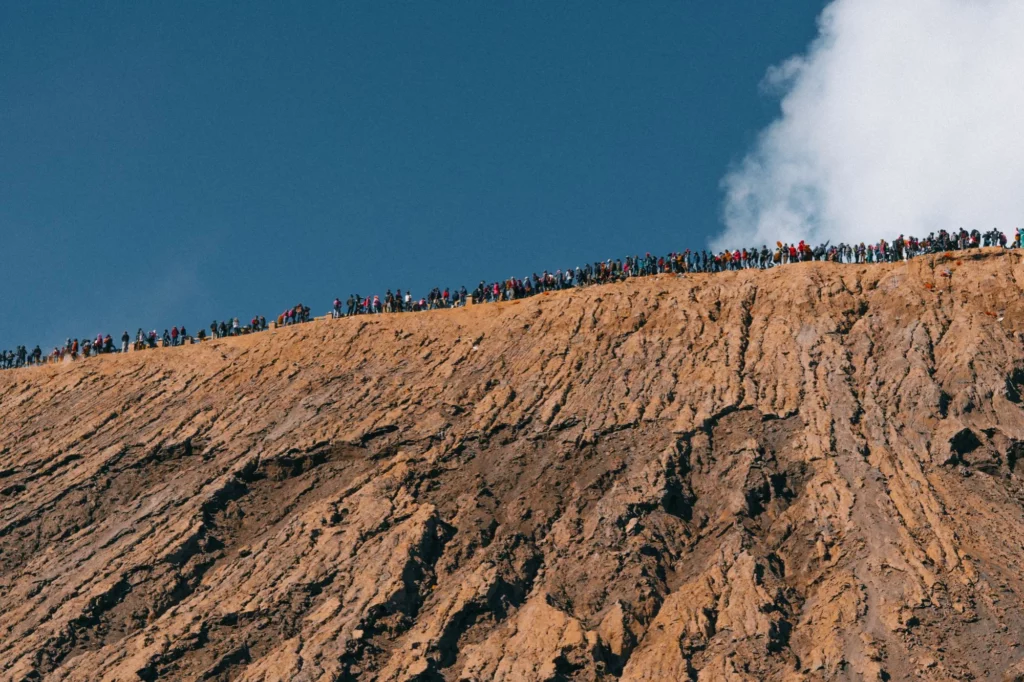
Faced with overcrowded sites and following examples such as the Tour du Mont‑Blanc and Lake Oeschinen, Switzerland is implementing an increasing number of local measures — from gondola reservations to fees and occasional closures — even though there is currently no nationwide rule requiring booking for hikes.
Context and tourist pressure
Tourism has recently reached record levels: according to a report, Switzerland recorded more than 60 million overnight stays in 2025, with Lucerne hosting nearly 9 million visitors. In this context, easily accessible and photogenic places attract crowds that strain infrastructure and local residents.
Local measures already in place
Several municipalities and sites have adopted targeted responses:
- Lake Oeschinen (Bernese Oberland): mandatory reservation to access the area around the lake between June 20 and September 20.
- Iseltwald (Lake Brienz): a paid turnstile on the jetty charges 5 francs for access.
- Lake Klöntal (Glarus): vehicle access will be banned on three Sundays per year.
- Lake Taney (Vouvry): a significant reduction in parking spaces, introduction of paid parking spots and reinforcement of public transport.
- Lucerne: a 100-franc tax for tourist coaches was introduced in 2025, a measure that halved the number of coaches according to the report.
- Oeschinen and other sites employ rangers and distribute trash bags to raise visitor awareness.
Hikes and mountain huts: practical cases
The Tour du Mont‑Blanc, visited by about 80,000 people a year, is at the center of a debate in France where hut reservations and controls have been proposed. In Switzerland, no national system equivalent to that is planned for now, but local measures already exist for highly frequented sites.
Several actors interviewed for the report express nuanced positions: Johanna Burgener (Pizol) considers that the 5-lakes hike does not need restrictions for the moment, Stoos offers alternative routes to disperse visitors, and the Swiss Alpine Club (CAS) defends free access to the mountains while acknowledging rising demand.
“We do not rule out that targeted, one-off management measures will become more common in the future at particularly busy sites.” — Remo Schläpfer, CAS
The CAS also reminds readers that huts already have a natural limit: “An overnight stay in our huts is only possible with a valid reservation.”
Major projects and adaptation: the example of Titlis
The Titlis region has experienced heavy visitation: the lift operators have invested in a major project (reported at CHF 150 million) aimed at strengthening the summit offer, while the threat of glacier loss is projected over a 20 to 30 year horizon. These choices illustrate the tension between infrastructure development and climate challenges.
What trend for the future?
Available information shows an increase in local responses — gondola reservations, turnstiles, occasional closures, coach fees — but no national harmonization. Local authorities combine awareness-raising, adaptation of public transport and parking regulation. It is therefore likely that further targeted measures will multiply, initially focused on the most accessible and most visited sites.